Intent Data vs Buying Signals: How to Use Both
Intent data vs buying signals: intent shows a company reading more about a topic, while a signal shows what changed there. Here is how to use both.

The difference between intent data and buying signals is what each one measures. Intent data is evidence that people at a company are reading more about a topic than they usually do. A buying signal is built from dated, sourced events at that company, such as a new CIO and a funded cloud program, that together point to a need.
Most writing on intent data vs buying signals frames it as a contest, usually by a vendor selling the winner. Chase every surge and your SDRs build a folder of polite "not right now" replies. Work only from the news and you tend to show up the week after the buyer picked the three vendors it will talk to. You need both, and you need what is already sitting in your CRM.
What is intent data in B2B sales?
Intent data, often sold as buyer intent data, is behavioral evidence that an organization is researching a subject, resolved to a company and grouped into topics. The most useful way to sort it is by who observed the behavior.
First-party intent: your own website and channels
This covers pricing page visits, repeat visits, webinar registrations, campaign replies and, for SaaS, trial or product usage. A named account returning to your pricing page three times in a week tells you more than most third-party topic scores. It is often your strongest intent and the most underused, because it sits in marketing tools sales rarely opens. Its limit is reach: it only sees accounts that have already found you.
Second-party intent: someone else's first-party data
Second-party intent comes from another site that sees buyers you cannot. G2's Buyer Intent is the clearest example: it triggers when an organization views your profile or pricing page, a category or comparison page that includes you, or a competitor's pages. The data identifies the organization; the individual viewer stays anonymous.
For a SaaS vendor, a company comparing you with a named competitor is well past general reading. For an IT services firm it usually matters less, since review sites are built around software products.
Third-party intent: co-op and bidstream data
Third-party intent is collected on sites you do not own and matched to companies, often by IP address.
Co-op intent data comes from a network of B2B publishers that share content consumption with a provider under their own consent and opt-out terms. Context is cleaner; coverage stops at the edge of the network.
Bidstream data is inferred from the bid requests ad exchanges pass around when a page with ad space loads. Coverage is wider; context is thinner and the consent chain longer.
Many platforms blend sources into one score, so if you pay for 6sense, ZoomInfo or Bombora, ask which sources feed the number you see. Forrester puts treating all intent sources the same on its list of the ten biggest intent data mistakes.
How is intent data measured, and what does a surge score mean?
Most third-party intent rests on one idea: compare a company with itself. The provider turns a company's content consumption into intent signals by topic, then checks whether recent reading is unusually high against that company's own history.
Take Bombora's Company Surge. A company is flagged as spiking on a topic at a score of 60 or more, which Bombora describes as a statistically significant increase over its historical baseline. So 60 does not mean "60% likely to buy". It means "reading about this more than usual, by enough that it is probably not random".
The baseline has a consequence sellers rarely hear about: steady heavy reading can look normal. In principle, a large bank that reads about cloud security every week could stay below the threshold during a real program, while a 300-person firm that suddenly reads a handful of articles surges. That follows from the definition, not from anything Bombora documents, so ask your provider how it handles this.
What intent data does well
Vendor posts that pit signals against intent skip this part.
Thousands of accounts get watched at once, including ones you have never touched.
It can be early: a company may read about endpoint detection well before it announces a security program or posts a CISO role.
With 2,000 target accounts and four SDRs, a surge report is a fair way to decide which hundred get looked at first.
It is a natural ABM input: it helps marketing decide which accounts and topics deserve a campaign.
Forrester's advice is worth taping above the SDR desks: do not use intent alone to qualify an account, and always read it alongside other data.
How accurate is intent data, and where does it fall short?
You do not know who was reading, or why
Intent resolves to a company. The reader could be a buyer, an intern, a consultant or one of your existing users. And a purchase is rarely one person's call: Forrester's State of Business Buying, 2026 found that a typical buying decision now includes 13 internal stakeholders and nine external influencers. A topic score points you at the building. It cannot tell you which of those people to call.
Topics are broad, especially in IT services
Say you sell a 24/7 managed SOC to law and accounting firms with 500 to 2,000 staff. A surge on "managed security services" could mean a SOC tender, a cyber insurer's questionnaire, a board asking about ransomware or one analyst preparing a slide. All four look identical in an intent feed. Services firms sell into project-shaped needs that topic taxonomies cannot separate from general reading.
Some research never shows up
IP matching misses research from home networks, VPNs and privacy relays, so a quiet account may just be invisible. If you buy bidstream-based intent for EU accounts, ask the provider in writing how consent was obtained; Forrester counts leaving privacy compliance to the vendor as a mistake of its own.
It decays fast, and you cannot say it out loud
Forrester ranks intent among the data types that go stale fastest. A six-week-old surge may describe reading that has already become a shortlist.
The bigger problem is what your rep can write. "Our data shows your company has been reading about cloud security" sounds like surveillance, so reps hide the reason and send something generic.
How event-based buying signals differ from intent data
Event-based buying signals start from dated, public facts about what changed: a new CIO hired from outside, a results statement that budgets for a modernization program, job posts for a team that did not exist last quarter. Each has a source anyone can open. Signal-based selling means starting from those changes rather than from what was read.
Signals explain why now, and a rep can say them out loud: "you announced a move of core banking to the cloud in your Q3 report" is something the prospect recognizes and can answer.
A single event is only an indicator, and plenty of new CFOs change nothing for a year. A new CFO plus a cost program in the annual report plus three finance-systems job posts in one quarter is a different story.
Your competitors read the same press release. They do not have your notes from the 2023 call with that CFO's predecessor.
Our guide to buying signals covers how to tell a real signal from noise, and the list of sales trigger events covers which events to watch and when.
Intent data vs buying signals, side by side
Question it answers. Intent: is someone here reading about this more than usual? Signal: what changed, and why might it create a need for what we sell?
Unit. Intent: a topic at a company over a recent period. Signal: dated, sourced events at one company that point to the same need.
Who it identifies. Intent: a company. Signal: a company and often a role, such as the new CFO.
How you verify it. Intent: you trust the provider's model. Signal: you open the source.
What you can say to the prospect. Intent: almost nothing. Signal: the fact itself, as your opener.
Main failure mode. Intent: wrong readers and stale surges. Signal: over-reading one event that never becomes a project.
Intent decides where to look. The signal decides what to say.
When intent data and buying signals disagree
Picture a grid: public signal yes or no, intent yes or no. Each box narrows which engagement motions fit, and only some put a rep in front of the account (the buying signals post covers the full set, from watch to direct outreach). The two boxes where the sources disagree are where most teams get it wrong.
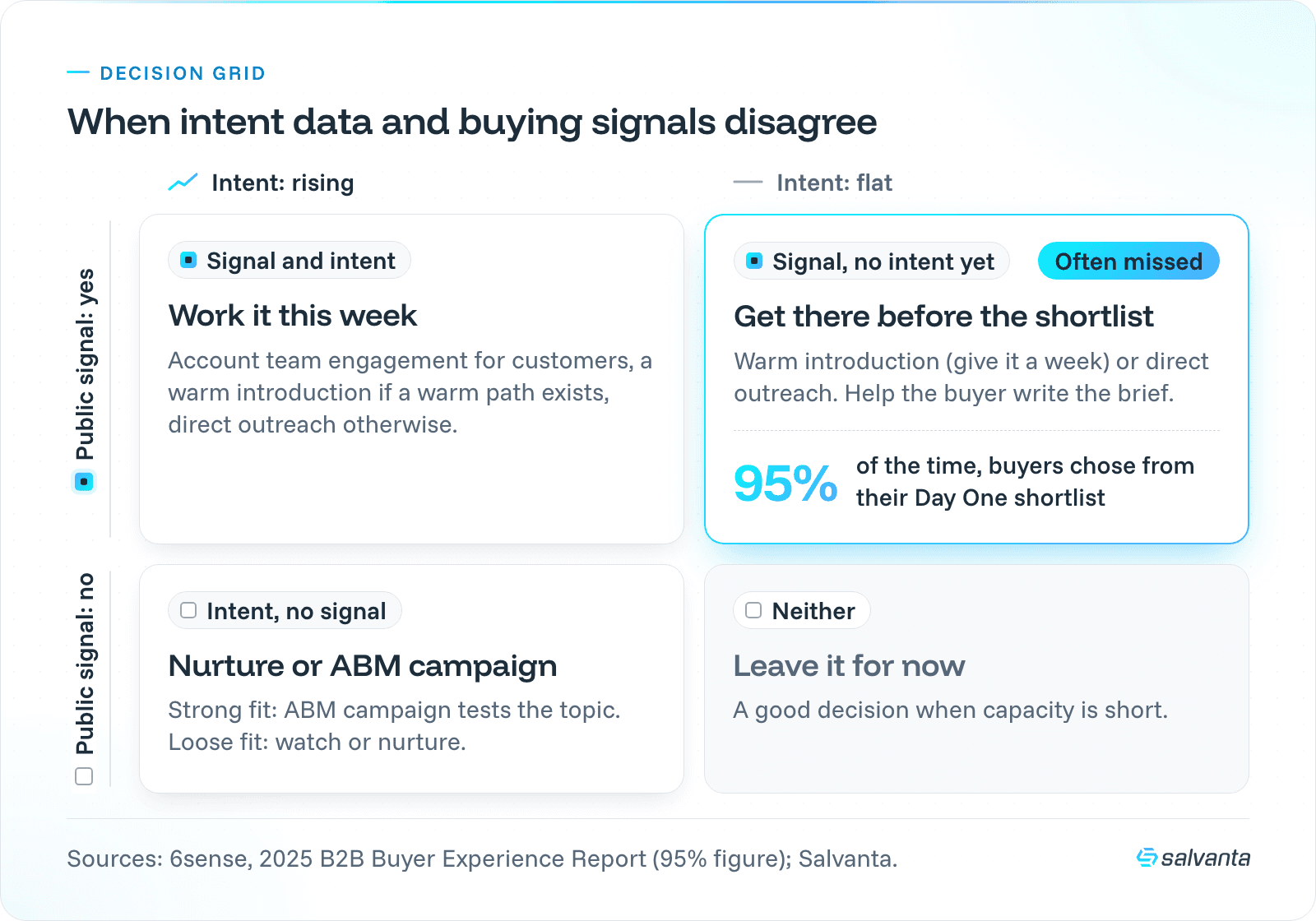
Signal and intent: work it this week
When a dated public event and rising intent line up, something changed and someone is researching. Confidence is high, and the relationship decides who moves first: the account team at a customer, a warm introduction where a former champion or partner knows the people involved, direct outreach otherwise. Whoever moves first, find the two or three people who own the change (the new CIO, whoever runs the program, procurement), open with the event, and get your VP or a practice lead on the first call rather than the third.
Signal, no intent yet: get there before the shortlist
This is the box most teams skip, and often the best one. Back to the managed SOC seller: a target appoints its first CISO, and its annual report budgets for a security program the same quarter. No surge yet, because she is three weeks in and has not started reading vendor content.
An ABM campaign here would mostly measure her silence. If a former champion, partner or board contact knows her, ask for the introduction and give it a week, not a month. Either way, the opener is the same: a one-page view of what a first-year security program at a 900-person professional services firm usually covers, and a request for 30 minutes to pressure-test it against her plans. You are helping write the brief before anyone has a shortlist.
In 6sense's 2025 B2B Buyer Experience Report, buyers' first contact with sellers came about 61% of the way through the buying journey, and buyers chose a vendor from their Day One shortlist 95% of the time. Wait for a surge to confirm interest and the shortlist may already be written.
Intent, no signal: nurture it or test it with an ABM campaign
Reading is up, but nothing public explains it, so a cold call has nothing true to open with. Check your website and CRM data first. With strong fit, or a dozen targets surging on one topic, an ABM campaign on that topic aimed at the likely buying committee tests the interest. With loose fit, watch it or put the committee in nurture, and check again in two weeks.
The response is evidence. Three people from one account at your SOC webinar is a new indicator, and one the prospect knows about, so together with the surge it can justify account team engagement at a customer, a warm introduction if you have a path and direct outreach if you do not.
Set the bar before launch, say two engaged roles in 30 days, or the campaign only tells you what the surge already did. Sales and marketing also need one owner per account while it runs, so the CISO who just clicked your ad does not get an SDR sequence on the same topic that week.
Neither: leave it
When an account shows neither a public signal nor rising intent, leave it for now. Passing on it this quarter is a decision, and a good one when capacity is short.
How to combine intent data with CRM data and public signals
Start from the accounts you choose
Begin with current customers, named targets and lookalikes of your best customers. Let a surge report pick your territory and you get whoever is reading this week, fit or not. Evidence at a customer goes to the account manager or customer success lead to raise in the relationship, at the next business review or sooner, never into a cold sequence. A customer surging on your own category may be pricing your replacement, which makes it a renewal conversation.
Join three layers per account
Is someone looking? Intent from all three sources.
What changed, and when? Public evidence: dated events, each linked to its source.
Have we been here before? CRM and website history: past deals and why they closed, contacts who left.
Most advice treats the CRM as the place data ends up. It works better as an input, because it is the layer most likely to change the first message. A joined record for a hypothetical specialty retailer, if you sell data platform services:
Public evidence: IT and data merged under a new COO in August, then six data engineering job posts in September.
Intent: research on data warehouse modernization well above the company's usual level.
CRM history: an opportunity lost on budget in 2023; your main contact has since left.
Likely need: a consolidated data platform under new ownership.
Roles likely involved: the COO as sponsor, the head of data engineering, security and procurement.
Motion: direct outreach, since the old contact is gone and nobody else offers a warm path.
Write the first message from the event
For this retailer, a first line could be: "Your team looked at us in 2023, when budget was the blocker. With IT and data now under one COO, the question may look different." The surge shaped the timing. It never appears in the email.
Keep people in charge of what enters the CRM
A surge alone should never create a sales task. It can justify nurture or an ABM campaign, or raise the priority of an account that already has evidence. Have someone with approval rights decide what becomes a lead or opportunity, with evidence, roles and outreach history attached, so the record explains itself later.
The one-sentence test: can you say it without mentioning intent?
Before a rep sends anything or asks for an introduction, have them finish this sentence: "I'm getting in touch because..." The ending must be something the prospect would recognize as true about their company.
"Because your company has been reading about cloud migration" fails. "Because you announced a move of your core systems to the cloud in your Q3 results" passes. If the honest ending is "because a dashboard turned orange", the account stays with marketing until something you can name turns up.
A quick audit: for your top 50 accounts, write down the last dated public fact you know. The blanks show where your team is guessing.
This is the working model behind Salvanta: buying intent is one input, joined with live public signals and your own CRM, website and campaign data into Signals in which every statement cites a dated, sourced fact. Each Signal comes with a suggested next step, but your team picks the motion, approves what enters HubSpot or Salesforce and sends any outreach from its own email or LinkedIn; Salvanta never contacts prospects itself.
Frequently asked questions
Is intent data the same as a buying signal?
No. Intent data shows that people at a company are reading more than usual about a topic, against that company's own baseline. A buying signal is a set of dated, sourced events, such as a new CIO and a budgeted program, that point to the same need. Intent can back up a signal, but alone it says little about what to tell the prospect.
What is bidstream data and is it reliable?
Bidstream data is intent inferred from the bid requests ad exchanges send when a page with ad space loads. It covers many sites, but page context is thin and the consent chain is long. Treat it as a coarse indicator, and ask the vendor how it matches the data to companies. For EU accounts, get the consent answer in writing.
What does a Bombora surge score of 60 mean?
Bombora flags a company as surging on a topic at a score of 60 or more, meaning its consumption of that topic is significantly above its own historical baseline. It is not a probability of buying, and it says nothing about who was reading. A large company that reads about the topic every week may not cross 60 if its interest is steady rather than rising.
How quickly should sales act on an intent surge?
Review it within days, because intent goes stale fast, but do not have a rep reach out on the surge alone. Act when something else corroborates it, such as a public event, visits to your own site or relevant CRM history. A surge with no other evidence belongs with marketing, in nurture or an ABM campaign on that topic.