Sales Trigger Events: 10 That Open a Buying Window
Ten sales trigger events that come before IT services and SaaS deals: where each shows up first, how long the buying window stays open and who to call.

Sales trigger events are dated, public changes at a company that make a purchase more likely in the months that follow. A new CIO, a completed acquisition, a budget line in an annual report, a regulatory deadline or a vendor's end-of-support date all count. Each one hands your team something specific and checkable to say.
Gartner found that 93% of B2B purchases take place in the context of organizational change: a shift in operations, market or structure. Nobody buys a managed SOC because a cold email landed on a Tuesday. They buy because something inside the company moved, and your job is to see it move early. (For how single facts add up to something worth acting on, see our guide to buying signals. This post is the field list.)
One note on evidence: we left out the conversion and win-rate figures this topic keeps repeating, since most trace back to vendor data or old commissioned surveys. Every number below links to a primary source.
How many accounts should triggers flag? The 95:5 check
Start with a base rate. John Dawes of the Ehrenberg-Bass Institute calls it the 95:5 rule: up to 95% of business buyers are out of market at any one time. If firms replace a provider about once every five years, roughly 20% are in market in a year and about 5% in a quarter. With a two-year cycle, it is around 13% a quarter. Dawes calls it a heuristic, so treat the percentages as rough.
Run the math backwards to check your alerts. Say you sell managed infrastructure and clients re-tender about every five years. On 500 accounts, something like 25 should be in motion this quarter. If your tool flags 180 as hot, the market has not changed.
Your filter is broken.
The other half of the problem is timing. Buyers tend to pick a favorite before they talk to anyone (the numbers are in our buying signals guide), so a trigger only helps if it reaches you before the shortlist forms. That favors early sales triggers, like a new leader, a budget statement or a hiring push. A published RFP is technically a trigger too. It is also the latest one possible.
Sales trigger examples: 10 B2B trigger events worth watching
Keep an event only if it is dated and sourced, maps to something you sell, and lets you name at least two roles. Each entry covers where the event shows up first, the window, the roles involved, and how it reads for an IT services firm versus a B2B SaaS vendor. The windows come from selling practice. No study we trust measures them, so check them against your own win data.
1. A leadership change in a key role
New CIOs, CISOs, CFOs and COOs review what they inherited. Say you sell application managed services to hospital groups and a regional health system hires a CIO from a large insurer. Within a couple of quarters she will probably decide which contracts stay.
At US public companies, a new principal executive officer, president, or principal financial, accounting or operating officer goes on Form 8-K (Item 5.02), generally within four business days. CIO and CISO hires are not on that list. They surface in press releases or on LinkedIn on no fixed clock, and some never get a press release.
Buying window: the first two quarters, while the new leader sets the agenda.
Who: the new leader, one or two direct reports, procurement.
A services firm should offer an assessment or a 90-day plan the leader can put her own name on. A SaaS vendor has a real shot when she used its product at her last company, or when the current stack is obviously her predecessor's pet project. The same logic applies when a former customer's champion joins a new company: they arrive with a vendor they already trust, and a note from the rep or account manager who worked with them beats any cold email.
2. A reorganization or a new function
A shared services unit that pulls finance, HR and IT support under one head, or a new transformation office. New owners review contracts. There is rarely a filing, so you piece it together from new LinkedIn titles and job posts reporting into a unit you have never heard of.
Window: from the change through the next planning cycle.
Who: the head of the new unit, the executive above them, and the executive whose team got moved, who often knows exactly what is broken.
A cost-driven restructuring opens doors for managed services and cost-out work, and it is a bad quarter to pitch net-new licenses. A growth-driven one hands SaaS vendors a new owner with no loyalty to the incumbent.
3. Budget and strategy statements in financial results
Annual reports and earnings calls are dull, which is why few reps read them. They are also where management commits in public to what it will spend on. When US public companies announce quarterly or annual results, they furnish the release under Item 2.02 of Form 8-K, and the call transcript carries the detail.
Window: the next budget cycle. A program named in third-quarter results often gets funded next fiscal year, so the conversation belongs in the fourth quarter.
Who: the CFO or finance partner, the named program owner, the CIO.
Ignore the boilerplate. "Digital transformation" is in every report. Look for named programs ("ERP modernization," "consolidating our data centers"), numbers, and capex or opex language tied to a function you serve.
4. Hiring patterns
Read hiring by function and by week, not post by post. Several roles in one team inside a month mean a team is being built. The strongest versions are the first hire in a function that does not exist yet, and roles naming a system the company does not run today, like Salesforce admins at a HubSpot shop.
Window: during the hiring push. Once the team is seated, the budget for outside help tends to quietly disappear.
Who: the hiring manager and the leader above them.
For a services firm, contractor roles or posts asking for "implementation partner" experience are the tell: someone plans to outsource part of the build. For SaaS, roles that name a competitor's product tell you the stack, and roles that name a category with no product suggest a selection is coming.
5. Funding rounds
Every vendor with an alert tool sees the funding press release the same morning, which makes this the most crowded trigger on the list. Under Regulation D, a company must file Form D within 15 days after the first sale of securities, so a round can hit EDGAR before any announcement. Either way it lags. The money is committed and the spending plan was written before the round closed.
Window: the build-out over the next few quarters.
Who: founders at early stage; later, the newly hired VPs who will choose tools.
SaaS usually fits better here, because new teams need tools. Services firms win when the round funds a stated plan, like a platform rebuild. Skip the congratulations and lead with what they said the money is for.
6. Mergers and acquisitions
Acquisitions create the work IT services firms are built for: every system both companies run now has to become one, on a timeline the board has usually promised investors. The announcement comes first. US public companies report completion of a significant acquisition on Form 8-K under Item 2.01.
Window: long. The best moment is often between announcement and close, when integration plans are written. After that, decisions arrive one system at a time.
Who: the integration lead, CIO, CFO, procurement.
Services firms sell integration, data migration and carve-outs. For SaaS it is a coin flip, since one of two tools in each category is about to go, and the acquirer's stack usually wins. Before anyone writes, check if you are the incumbent at the buyer or at the target. If you are, the account team makes the first move.
7. Expansion
A new country, site, product line or segment. Say you sell network and managed IT services to logistics companies, and a prospect announces a distribution hub two states away. Someone has to wire, secure and support it, and those decisions are made months before the doors open. Look for it first in press releases, local permit news and job posts for the new site.
Window: from the announcement until roughly a quarter before opening. Once the site is live, the network and support vendors have been chosen.
Who: the regional GM, head of operations, IT infrastructure lead.
Be wary of expansion news with no dates or headcount, which usually means marketing wrote the announcement before operations wrote a plan.
8. Regulatory deadlines
IT services firms underuse this one, even though they can see it coming a year or more ahead. By the time the deadline arrives, the work has already been bought.
A live example: the EU Cyber Resilience Act entered into force on December 10, 2024. Its reporting obligations have applied since September 11, 2026, and its main obligations apply from December 11, 2027.
Deadlines also move. The EU's AI Omnibus, in force since July 27, 2026, pushed the AI Act's high-risk rules to December 2, 2027 (Annex III systems) and August 2, 2028 (AI embedded in products, Annex I). Plenty of articles still give the old Annex III date of August 2, 2026, so check the regulator's own page before you quote a date to a CISO.
Window: 12 to 24 months before the deadline, when compliance budgets get set. The final quarter is firefighting, and rushed buyers pick whoever they already know.
Who: the CISO, compliance, product security, legal and, at software makers, the head of engineering.
Services firms sell gap assessments, secure-development programs and remediation. SaaS vendors sell tooling for vulnerability handling and evidence. Confirm the account is in scope first.
9. Technology end-of-life and migrations
Also scheduled, and most infrastructure and ERP partners already plan their year around them. Windows Server 2016 extended support ends on January 12, 2027. Any account still running it in production this fall either has a migration in flight or a paid-support bill on the way. SAP provides mainstream maintenance for SAP Business Suite 7, including SAP ERP 6.0, until the end of 2027, with optional extended maintenance to the end of 2030 at a premium of two percentage points.
Window: 12 to 24 months before the date, and again just after it, when stragglers start paying premium support fees.
Who: the CIO, the infrastructure or ERP owner, the enterprise architect, and the CFO once extended support fees hit the budget.
Do not assume everyone on an old version is moving. Many will pay and wait. Pair the date with a second fact (migration job posts, a named program, a partner RFP) before you treat an account as active. SaaS vendors gain when a migration becomes the moment to replace adjacent tools.
10. A disclosed security incident or audit finding
US public companies must report a material cybersecurity incident on Form 8-K under Item 1.05, within four business days after determining it is material. Handle this one with care. "Saw you had a breach" is ambulance chasing, and CISOs remember who did it.
Window: not the first days, when companies with an incident-response retainer call that firm, but the months of hardening and audit work that follow.
Who: the CISO, CIO, and risk or audit.
Services firms have a real offer here (remediation, managed detection, incident readiness). Net-new SaaS rarely does, unless it fixes exactly what failed.
How long the buying window stays open: scheduled, announced, inferred
The most useful way to sort sales trigger events is by when you can first see them. That decides how often you check, which engagement motion fits, and what your first line says.
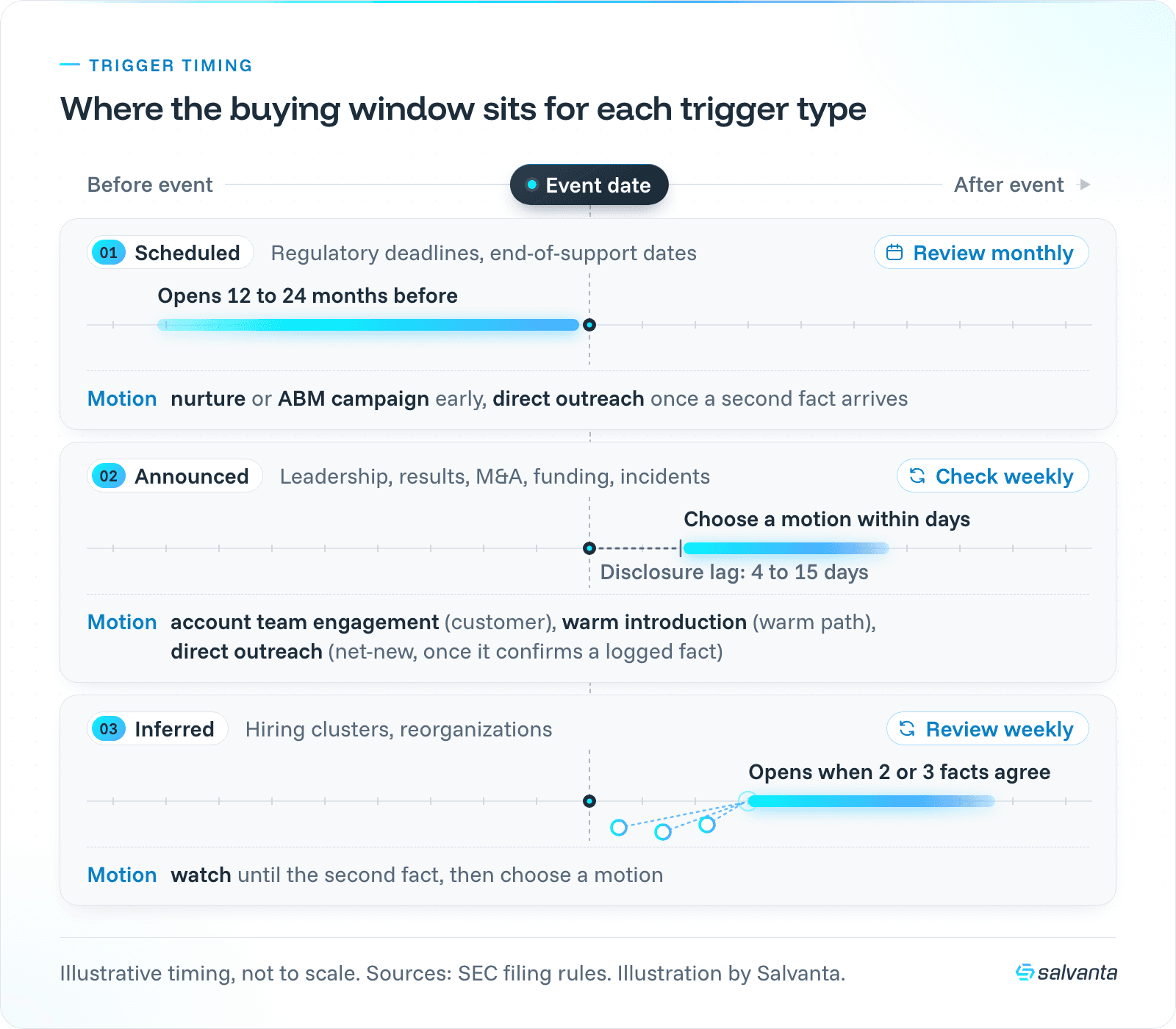
Scheduled triggers are known months or years ahead: regulatory deadlines, end-of-support dates, fiscal year-ends, renewals. Keep a calendar per account and review it monthly. Start with nurture while the date is far out, and when you go direct, open with the date and what it means for them.
Announced triggers go public at or after the event: leadership changes, results, M&A, funding, incidents. Disclosure clocks (up to four business days for an 8-K, 15 days for a Form D) mean a "new" fact may already be two weeks old, and competitors see it too. Check weekly at least. At a customer, the account team moves right away. At a net-new account, move fast when the event confirms something you already logged, and lead with a specific angle.
Inferred triggers exist only once you connect several facts: hiring clusters, reorganizations, a function taking shape. They are the least crowded buying triggers, because most alert tools fire on single events. Review weekly and wait for the pattern.
Most teams run all three through one feed. That is how a deadline gets noticed six weeks out instead of eighteen months out.
Who to contact after a trigger event, and how to open
A cold email is one answer to a trigger, and often not the best one. Pick the engagement motion first, based on three things: confidence (how many independent facts agree, how recent, how close the fit), your relationship with the account, and how near the decision is. The full framework is in our buying signals guide. Four cases come up most:
A regulatory deadline a year or more away, and nothing yet says the account has started: nurture, or an ABM campaign on that topic to see who engages. A sales sequence before you have a second fact teaches the CISO to ignore you.
A new executive at a customer: account team engagement, and soon. The account manager asks for an intro meeting in her first few weeks, because a new CIO is a renewal risk before she is an expansion. Never cold-sequence your own customer.
A warm path into a net-new account (a former champion now there, a partner who covers it, an investor or board connection): a warm introduction. Give the introducer a few days before anyone falls back to a cold email.
An announced event that confirms something you already logged, at a net-new account with no warm path: direct outreach, fast and specific, before the announcement gets crowded. If it is the only fact you have, it goes on watch like any other single indicator.
Whatever the motion, map three roles: the person who owns the change, a peer who lives with the problem, and whoever approves the spend. A trigger tells you who is likely to start the conversation. It rarely tells you who signs.
Motions can run in sequence. Say you sell secure-development services to software makers, and 40 accounts on your list ship products into the EU. A Cyber Resilience Act readiness campaign aimed at their engineering and product security leads shows you which ones are working on it. The six where those leads download the checklist or register for the session get direct outreach. The other 34 stay in nurture. Clicks from people outside the buying committee do not count. Aimed at accounts with no dated trigger, the same campaign mostly measures general curiosity. The weekly review in the setup below is where sales and marketing settle which single motion each account is in, and who owns it.
For direct outreach, lead with the fact, the date and where you saw it, plus one sentence on what it usually means. For a warm introduction, give the introducer the same lines to pass on. At a customer, the account manager brings them to the conversation. A hypothetical opener from a services firm: "Your second-quarter report names a plan to consolidate three regional data centers by the end of 2027. Teams doing that on Windows Server 2016 usually hit the January support date first." The buyer can check it in ten seconds, and even a "not yet" tells you when to come back.
Skip congratulations-only notes, anything about a breach in the first line, and people's personal posts. Nobody wants a cold email that mentions their kid's soccer tournament.
How to track sales trigger events without drowning in alerts
The usual failure is 400 sales trigger alerts a week, all marked urgent, and a team that stops opening them by week three.
Watch a defined account list
Your customers, your targets and lookalikes of your best customers. An account outside the list earns a spot by showing two dated triggers in the same quarter. Use the 95:5 arithmetic above to set how many should light up, and raise the bar when far more do.
Wait for two or three events before you go direct
A single trigger, even a scheduled, high-fit one like an end-of-support date for a platform you migrate at an account you know runs it, earns watch, nurture or an ABM campaign on the topic rather than direct outreach. Keep it there until two or three independent, dated events at the same account point to the same need. A new CIO is an indicator. A new CIO, four cloud engineering roles and a modernization program named in results is a reason to act: through the account team if they are a customer, a warm introduction if you have a path, direct outreach if you do not. Our buying signals guide covers how to weigh corroboration, recency and fit.
Treat intent data as one input
Topic intent says someone at the account is researching. It does not say why, or who. Use it to rank accounts that already have a dated trigger. The trade-offs are in intent data vs buying signals.
Keep the source attached all the way into the CRM
When a trigger becomes an opportunity, the record should carry the fact, the date and the link, and someone should own approving what gets logged. Six months later, "Signal: security" with no evidence helps nobody.
A four-step setup for trigger-based prospecting
Pick the five to seven triggers above that map to what you sell, and write the "so they will probably need..." line for each.
Calendar the scheduled ones now: which accounts run Windows Server 2016 or SAP ECC, which sell software into the EU.
Book a weekly 30-minute review of announced and inferred triggers with marketing, hold to the two-fact rule, and give each active account one motion and one owner.
After a quarter, check which trigger types and motions produced meetings, and cut the rest.
Where Salvanta fits
If you'd rather not run this by hand, Salvanta watches the accounts you choose for events like these. It joins them with buying intent and your CRM, website and campaign data into Signals, and every statement links back to a dated source. Your team gets a suggested next step, the roles likely involved, an angle and a first draft to edit and send from its own email or LinkedIn. Your team decides which motion fits and runs it. Salvanta never contacts prospects itself and does not run ads, ABM or nurture campaigns. Nothing lands in HubSpot or Salesforce until someone with approval rights says yes.
Frequently asked questions
What is trigger event selling?
Trigger event selling is prospecting that starts from a dated change at an account, such as a new CIO, an acquisition or a support deadline, instead of from a static list. You act because something moved, and when you reach out, your first line names the fact, the date and where you saw it. It works best when the event maps directly to something you sell.
How soon should you reach out after a trigger event?
Match speed to the timing type. Decide on announced triggers, like a new executive or a funding round, within days, because competitors see them too. Start scheduled triggers, like a regulatory deadline, 12 to 24 months out with nurture or an ABM campaign, and go direct once a second fact arrives. Wait on inferred triggers, like a hiring cluster, until two or three facts agree, then move quickly.
Are layoffs or restructuring a sales trigger?
Yes, but a negative one, and it reads differently by seller. For IT services firms, a restructuring with a cost program can open conversations about managed services, consolidation or cost-out, because the work still has to get done with fewer people. For most net-new SaaS it means frozen budgets. Open with the work the cost program still needs done, and keep the headcount numbers out of your email entirely.
How do you track sales trigger events for free?
Pick 20 to 50 accounts and check a few sources on a fixed schedule: SEC EDGAR for 8-K and Form D filings, company press and careers pages, LinkedIn for leadership moves, and vendor lifecycle pages for end-of-support dates. Log each fact with its date and link. It works, but it gets slow beyond a few dozen accounts.